

I must be missing something.
I thought it was pretty straightforward.

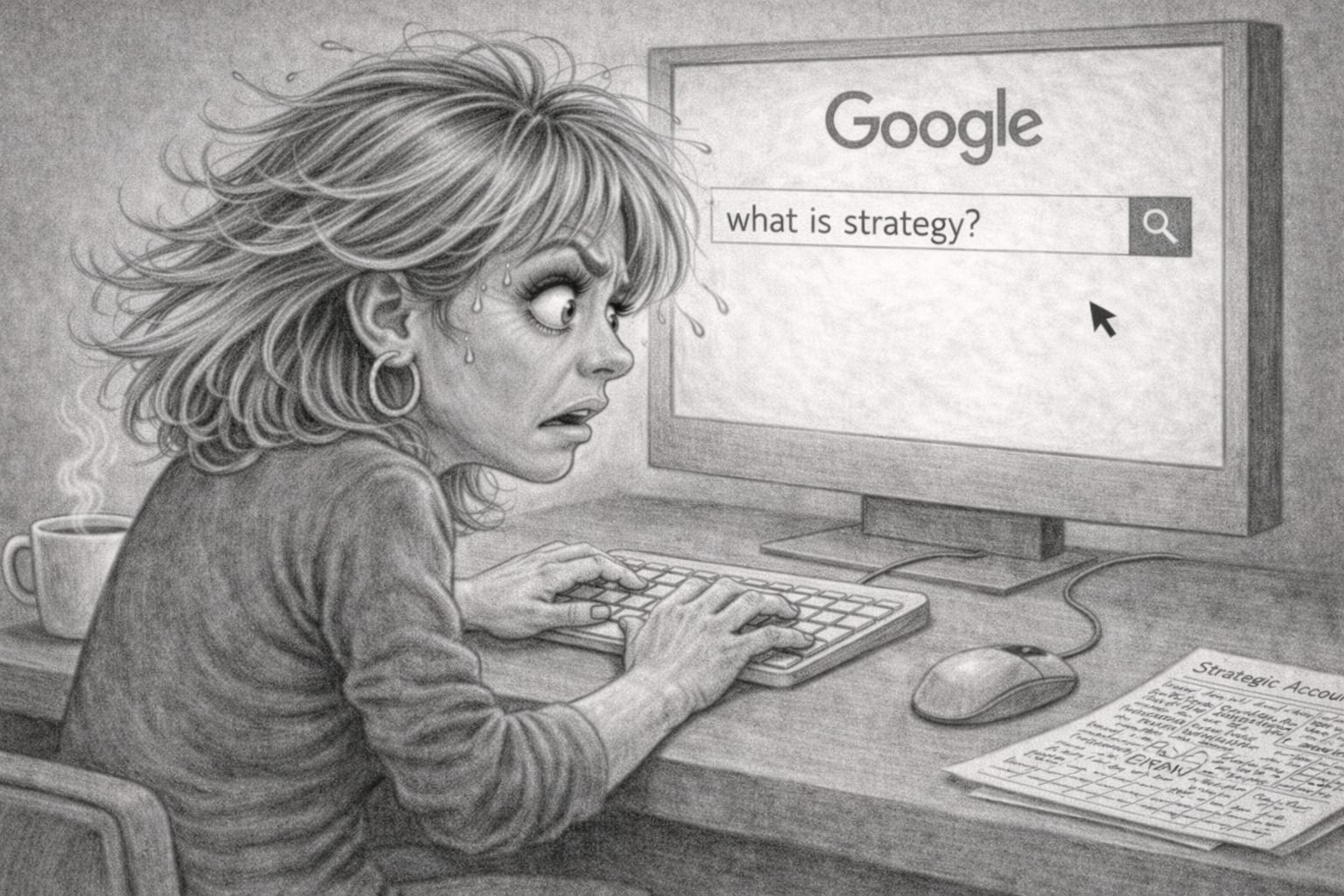
I was reading The Intentional Manager’s post The age-old question: what is strategy? and immediately thought, “Oh good, it’s not just me.”
There was a point in my career where I Googled “what is strategy?” out of pure frustration.
I really thought I had a good handle on it - but the people in the room were throwing the word around in ways that made me doubt my understanding.
Some saw strategy as a goal: “grow market share by 10%.” Others saw it as activity: “meet with key customers quarterly.” Still others saw it as a list of tactics.
I couldn’t fault anybody for their confusion. It started at the top.
The company’s annual priorities came out at the end of the first quarter every year. (That was the first problem. Leadership shared the annual priorities when we were already well into said year.)
The priorities arrived with great fanfare, in a fully designed one-pager containing color-coded pillars:
Growth: A few of our newer products listed by name. No details about what we were shooting for in terms of growth: share, influence, access. Just the names.
Innovation: The acronym of whatever the latest corporate initiative was. Not the full name of the initiative, let alone the objective.
Financial: A vague reference to “cost control” - no numbers or percentages.
Operational Excellence: essentially “cost control” with different words, amounting to “do more with less.” No mention of how much less. Or what the “more” was.
People: Some variation of “be the employer of choice” or “embed culture.” No mention of to what end: recruitment or retention targets, for example.
It was a big company, led by very smart people. I know there was a lot of rigor put into those priorities.
If you sat through the quarterly town hall, various leaders would take turns talking about these pillars. You could glean more detail if you paid attention.
But there wasn’t one comprehensive resource you could lay your hands on that would clearly explain what we were shooting for. This made it tough to create departmental, team and individual objectives for the year.
And the variation in THOSE was mind-blowing. If you looked at a cross-section of strategic plans across the organization, you’d think we were all working for different companies.
I made it my business to police our annual strategy sessions so we’d end up with something, you know, strategic. In Market Access, where I spent most of my career, it might look something like this:
Where we’re focusing and why: We’re focusing on large health systems in the Northeast because they influence what gets prescribed across entire networks.
What distinct approach will achieve a specific outcome: We’re going to win by giving system leaders a practical playbook they can roll out across sites to make prescribing more consistent.
What we’re NOT doing and why: We’re not spending time on small independent practices because they don’t move the needle at a regional level.
Strategy wasn't the problem at that company. The thinking was sound.
The problem was that what reached the rest of us looked nothing like a strategy - it looked like a poster.
You can’t build on a strategy you can’t see - which is how people end up filling the gaps themselves. And it’s how you end up in a room full of smart people who can’t agree on what “strategy” is.
I write about what happens inside these organizations. Luca writes about why it happens and what to do about it. He’s The Intentional Manager. (I’m more The Accidental Manager.) Check him out here.