

How long before they find out I'm a fraud?
The only time they're wrong is when they think I'm right.

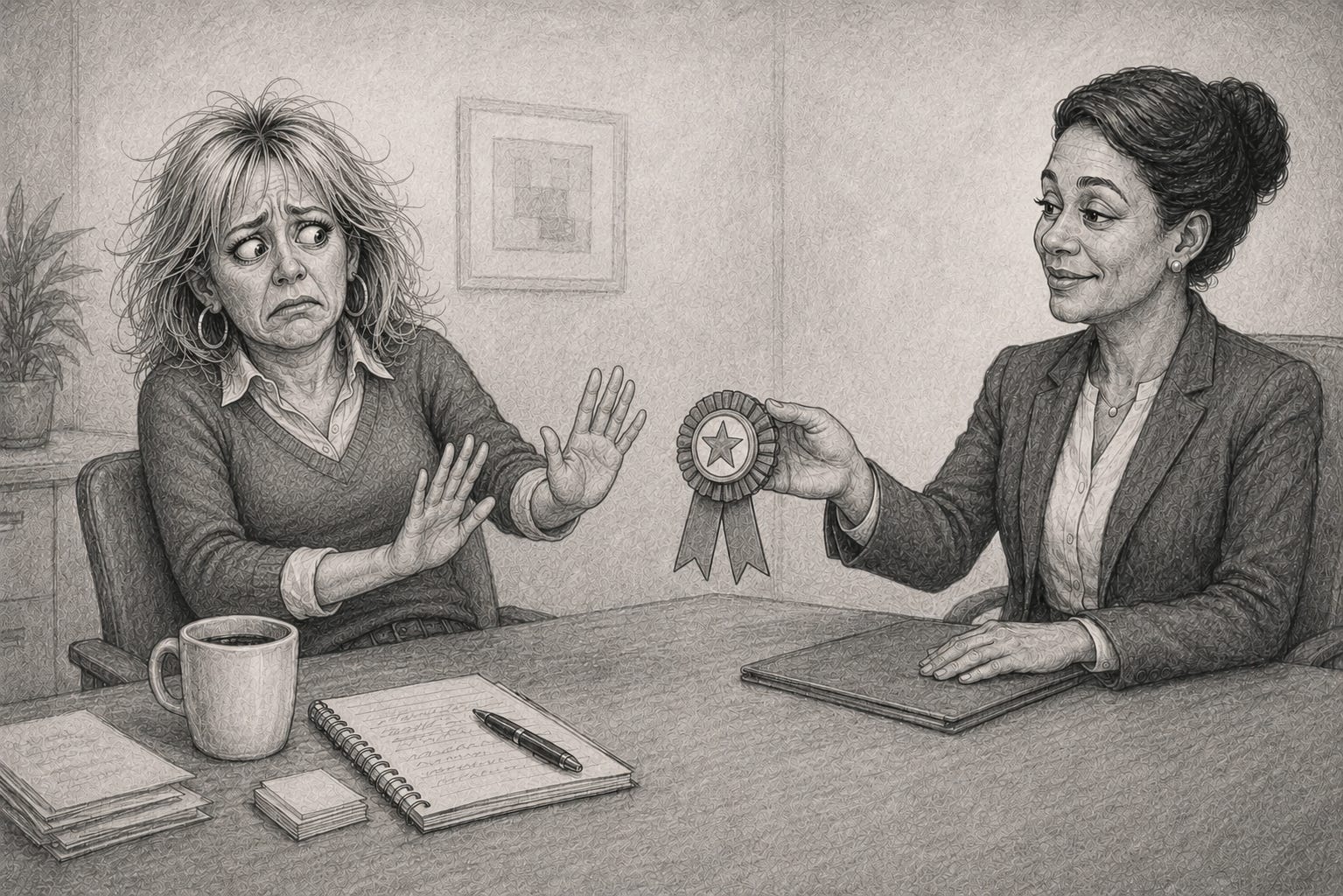
Years ago, as my manager was giving me my annual performance review, I realized with a growing sense of panic that I had no idea what she was talking about.
Nothing she was saying sounded anything like what I’d experienced that year.
I wish I could tell you what she said - but my thoughts were so loud I couldn’t hear anything.
She has no idea how much research I had to do before I even understood what I was supposed to be doing.
I had to pull in three other people to get some of this done because I didn’t have the background.
I must have drafted 20 versions of that strategic plan. It took me forever.
She wasn’t saying ANY of that. She was talking about my impact and the things she thought I could be doing next.
Like I had really accomplished something.
If she knew how much I struggled to do some of this stuff she wouldn’t be saying any of this.
I’m pretty sure I thanked her, asked her if she needed anything, then bolted.
What I do remember very clearly is walking back to my office and immediately typing into the Google search bar:
What do you do when your boss believes in you too much?
I respected this woman tremendously. She was a trailblazer who had shot up the corporate ladder like a rocket. I thought she was brilliant, and I trusted her judgment.
Usually.
This time, though – she was wrong. About me.
I didn’t know what to do with her confidence in me. It felt utterly misplaced.
I’m a fraud. I didn’t do whatever she thought I did. I can’t be what she thinks I can be.
I had loads of evidence that she’d mischaracterized my contributions.
All the discarded drafts, the hours I’d spent trying to understand various concepts everyone else already seemed to know, all the things I’d messed up before figuring out what was wrong.
What I didn’t realize until much later - as in, when I sat down to write this post - is that it was the struggles, the over-prepping, the revisions, and the things I learned the hard way that had brought about the end result she’d hailed as a success.
All the work I’d done to avoid being exposed as a fraud became the reason I’d succeeded.
When I first encountered an article about “imposter syndrome,” I was convinced I’d figured it out.
Mainly because I’d latched onto “imposter” and overlooked the “syndrome.”
Imposter! Yes! That’s me! People think I know way more than I do, that the things I’ve done are somehow more meaningful than they really are. What do I do about that?
Of course, once I got past the headline, I learned there’s a big difference between being an imposter and having imposter syndrome.
An imposter pretends to know things they don’t. They overstate their expertise, accept credit that isn’t theirs, and avoid learning so as not to expose the gap in their knowledge.
That was never me.
I never pretended to know things I didn’t know. I was painfully aware of what I didn’t know – and worked tirelessly to remedy it. I never claimed expertise I didn’t have. Half the time, I resisted claiming expertise I probably did have. I didn’t accept credit for things I did, let alone what others did.
And learning was all I ever wanted to do.
So - not an imposter.
Imposter syndrome, on the other hand, is a persistent belief that you’re a fraud who is undeserving of your success - despite plenty of evidence to the contrary.
My manager handed me evidence that day during my review. And I’d deemed it inadmissible.
Even after learning all this, I still wasn’t convinced. I couldn’t fully accept imposter syndrome as a thing.
How do you know if you have imposter syndrome – or if you are, in fact, just an imposter?
That’s how insidious imposter syndrome can be. You can’t even accept that that’s the problem because you don’t believe you are actually competent enough to have it.
I didn’t think about all this again until I started this newsletter - where I revisit the work episodes that still haunt me. The most painful lessons are the ones that stick - and those are the ones I mine for weekly content.
The more time you spend reflecting on the past, the more memories you unearth. And I started seeing a pattern.
The time an executive suggested me for a director role - which I immediately declared I wasn’t ready for.
The self-appraisal I’d outsourced to a talented writer friend because I couldn’t describe my own work beyond a list of “here’s the stuff I did.”
It even extended as far back as my pre-corporate days, when as a young reporter I was given a chance to interview a visiting Golden Globe nominee. I passed on it because I couldn’t see how he could possibly take me seriously.
I’m writing about it now not because I’ve overcome it - I haven’t - but because I can see now what it has cost me.
It’s kind of a bummer.
But I can also see what it’s given me.
Because I feel like a fraud, I do everything I can not to be one.
That means reading insatiably, taking online classes, organizing what I’ve learned into usable insight. I’ve developed an unparalleled level of nerd skills that I can apply to just about any situation.
I might feel like an imposter, but I am in no way resigned to actually being one.
So this is what I’ll be writing about for the foreseeable future - since I seem to have a lot to say about it.
Mainly, I’m thinking imposter syndrome could use a rebrand. Maybe it’s less of a syndrome and more of a superpower. There’s got to be a way to harness it.
If imposter syndrome insists on being here, the least it can do is earn its keep.


Well said. Maybe the rebrand is calling it identity lag — the space between the person we’ve been and the person we’re becoming.